
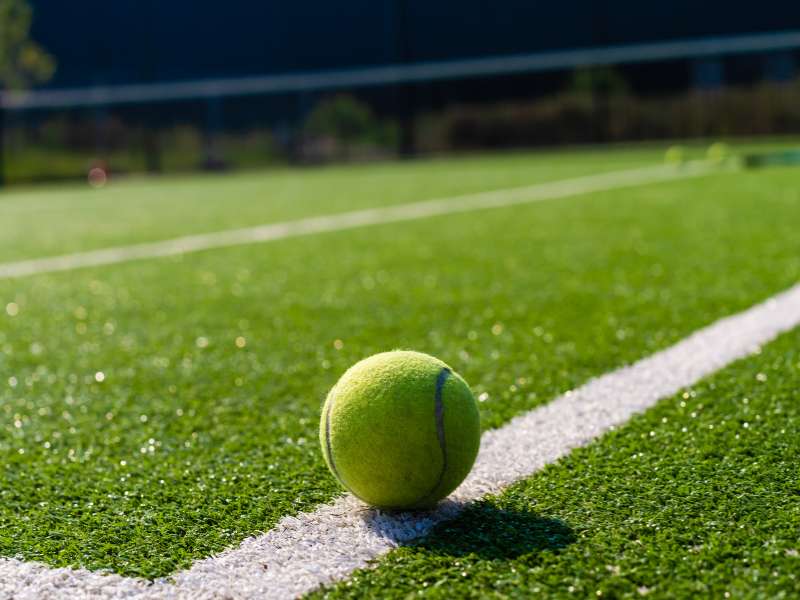
As synthetic turf technology advances, its use has expanded far beyond landscaping. Today, artificial sports turf has become an essential surface for golf putting greens, hockey fields, tennis practice areas, indoor gyms, and functional training zones. Its stability, durability, and ability to maintain consistent performance make it a preferred choice in both recreational and professional environments.
This article offers a clear and informative overview of sports turf—its structure, performance characteristics, and suitability for different types of sport.
1. The Fundamental Structure of Sports Artificial Turf
Although sports turf appears simple on the surface, it is built from a combination of precisely engineered components. Each layer contributes to its professional-grade performance.
1. Yarn
Sports turf yarn is commonly made from polyethylene (PE), known for its soft yet resilient properties. PE yarn offers:
High abrasion resistance
Strong elasticity
A safe, smooth sporting surface
UV protection is often added to ensure long-term colour stability under sunlight.
2. Turf Density (Gauge & Stitch Rate)
Two important measures determine the density of sports turf:
Gauge: Distance between rows of turf yarn
Stitch Rate: Number of stitches per metre
Sports surfaces typically use dense configurations to create a firm, even playing field essential for ball control and athlete stability.
3. Pile Height
Sports turf commonly ranges from 10–20mm in height.
Shorter pile heights provide:
Faster ball movement
A consistent surface
Greater precision for sports like golf or hockey
4. Dtex (Yarn Linear Density)
Dtex measures the weight of 10,000 metres of yarn.
Higher dtex → stronger, thicker, more durable fibres
In sports applications, strong yarns help handle repeated impact and heavy foot traffic.
5. Backing System
Professional sports turf often uses a multi-layer backing consisting of:
Woven polypropylene cloth
Non-woven layers
A stabilising latex coating
These layers hold yarns firmly in place and provide structural stability during high-intensity use.
2. What Makes Sports Turf Different from Landscaping Turf?
Sports artificial turf is designed with performance and precision in mind. Compared with decorative or landscaping turf, sports turf offers:
1. Consistent Ball Roll
A smooth, firm, low-pile surface allows balls to travel predictably—crucial for golf putting and hockey.
2. High Durability
Sports training involves repetitive movement, sharp footwork, and heavy friction.
Thus, sports turf requires:
Stronger yarns
Higher stitch density
Better backing stability
3. Enhanced Safety
Quality sports turf reduces slipping risks and minimises abrasions, offering a safer environment for athletes.
4. Weather and Wear Resistance
UV-stabilised fibres and strong backing ensure the surface maintains colour, shape, and performance over long-term outdoor use.
3. Application of Sports Turf in Various Sports
Different sports impose different performance demands, which has led to specialised turf designs and structures.
1. Golf (Putting Greens)
Golf putting turf requires:
Very low pile height (10–15mm)
Perfect smoothness
Uniform ball speed
Artificial turf effectively simulates the roll of natural greens with minimal maintenance.
2. Field Hockey
Hockey surfaces must be:
Fast and smooth
Low friction
Highly uniform
Dense turf structures ensure accurate ball direction and player control.
3. Tennis
Tennis practice areas need turf that provides:
Consistent foot grip
Stable bounce characteristics
High wear resistance
This supports lateral movement and repeated directional changes.
4. Gyms & Functional Training Zones
In fitness settings, turf is used for sled tracks, agility lanes, and cross-training zones.
Key requirements include:
Impact resistance
Dimensional stability
Strong, upright fibres that withstand heavy loads
4. Advantages and Limitations of Sports Turf
Advantages
Usable year-round
Low maintenance compared to natural grass
High consistency across the entire playing area
Safe and durable surface for repeated use
Limitations
Some professional competitions still prefer natural grass
Not all models are suitable for very wet environments
Requires a well-prepared base for best performance
5. How to Choose the Right Sports Turf
From an educational standpoint, selecting sports turf involves evaluating a few fundamental criteria:
Intended sport or activity
Pile height and density requirements
Durability and dtex level
UV protection for outdoor use
Strength and construction of the backing system
Understanding these core parameters helps identify turf types that meet the performance needs of a specific sport or area.
Conclusion
Sports artificial turf plays a significant role in modern athletic facilities, thanks to its engineering, safety features, and consistent performance. Supported by advancements in materials science and manufacturing, it offers a reliable solution for various sports, training environments, and indoor or outdoor setups.
As technology continues to evolve, the future of sports turf will focus on improved sustainability, enhanced realism, and broader application across both amateur and professional sports.